Why investors reject startup applications
Most founders spend hours writing their startup application. They rewrite the tagline, polish the product description, and add words such as AI-powered, scalable, intelligent and disruptive. Then they press submit and wait.
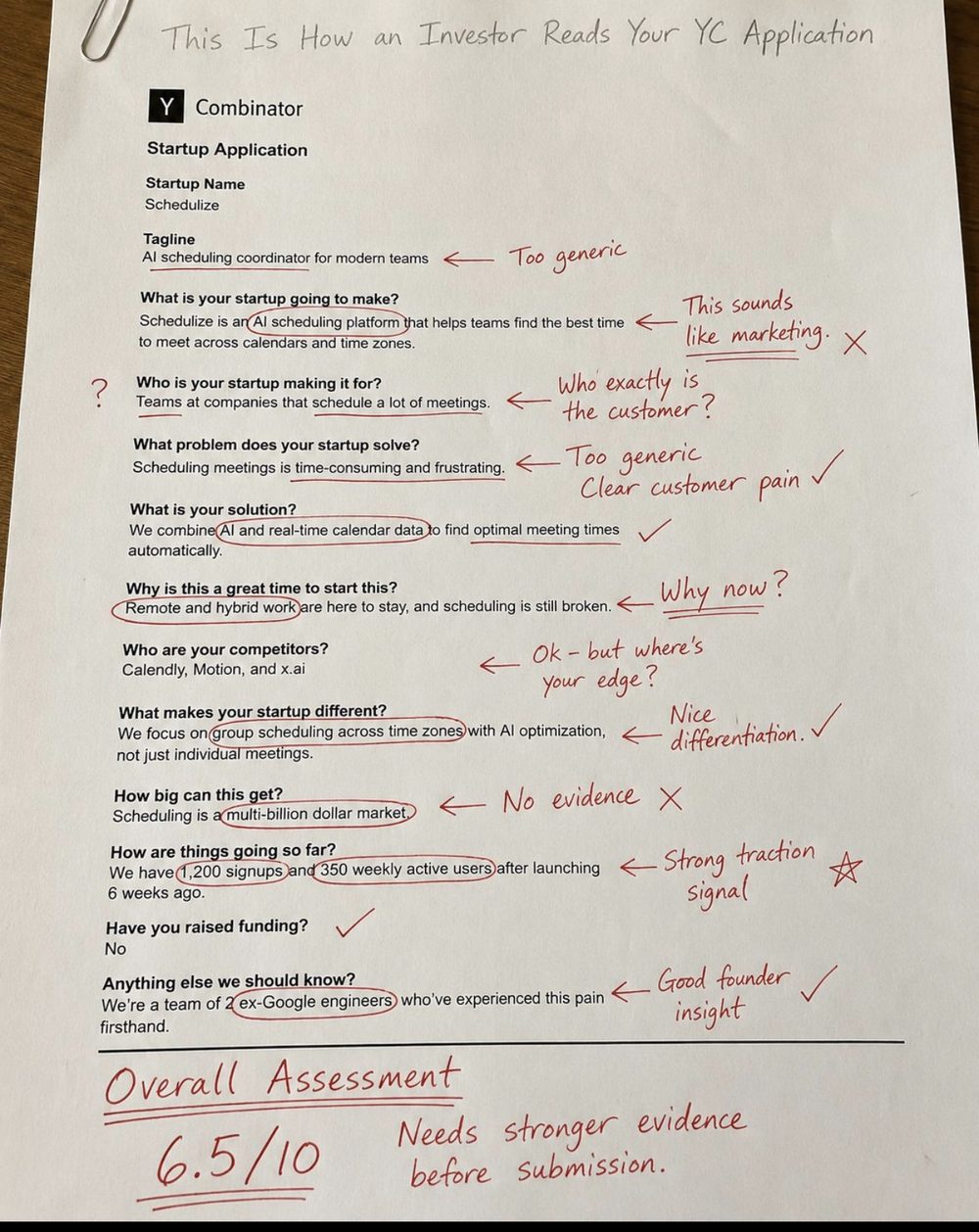
But investors do not read startup applications the way founders write them. Founders read every answer as part of one connected story. Investors often read each answer as a test. They are trying to understand, very quickly: what exactly is this company building, who needs it badly enough to pay, why does it need to exist now, what makes it different, is there evidence the market cares, can this team execute, and is the opportunity large enough to matter.
The annotated application above is a perfect example. The company appears credible — a working product, early users, an experienced team. Yet the overall assessment is only 6.5 out of 10. Not because the idea is weak, but because too many answers remain generic. The application describes a startup. It does not yet make the investor believe in it.
Investors are reading for clarity, not creativity. Take the tagline: “AI scheduling coordinator for modern teams.” It sounds polished, but it immediately creates questions. What is a modern team? A startup? A global enterprise? A recruitment department? Broad language pushes the work back to the investor, who now has to guess who the product is for. A stronger version would be: “AI scheduling for global recruitment teams coordinating high-volume interviews across calendars and time zones.” Less fashionable, but it tells the investor who the customer is, what the product does, and where the complexity lives. Do not try to sound bigger than you are. Try to sound clearer than everyone else.
“We are an AI platform” is not a product description. Investors have seen thousands of startups described as AI-powered platforms, intelligent ecosystems, seamless digital solutions, next-generation infrastructure. These phrases do not explain what happens. A good product description describes the workflow. Compare a fintech example. Generic: “We are building an AI-powered compliance platform for financial institutions.” Specific: “We connect to product documents, customer journeys and internal policies, then identify where a planned fintech product may conflict with current regulatory requirements before launch.” The second turns an abstract platform into a concrete outcome.
Your customer cannot be “everyone who has the problem.” The sample application says its customer is “teams at companies that schedule a lot of meetings.” But nearly every company schedules meetings. Investors want to know where you will begin. Early success usually comes from a narrow group with a painful, frequent, expensive problem. “Recruitment operations teams at companies with more than 500 employees that coordinate multi-stage interviews across several countries” is a real segment. For fintech, instead of “we serve SMEs that need better financing,” say “we serve UAE trading businesses with annual revenue between AED 5 million and AED 50 million that struggle to obtain short-term working capital against unpaid invoices.” Specificity does not make your company look smaller. It makes your entry strategy look believable.
Describe the cost of the problem. “Scheduling is time-consuming and frustrating” is true, but it is not yet a business problem. Investors want to know what the problem costs — wasted time, delayed revenue, customer drop-off, compliance risk. “Recruitment coordinators spend 10 to 15 hours each week arranging panel interviews across time zones; delays increase candidate drop-off and slow hiring” turns inconvenience into impact. The same rule applies in fintech: not “compliance is complicated,” but “early-stage fintech teams spend weeks manually reviewing product journeys against regulatory requirements, often discovering gaps late in development when changes are more expensive.” Pain becomes investable when it has a measurable consequence.
Technology alone is not differentiation. “We combine AI with real-time calendar data” describes the technology, not the advantage. Calendly can add AI. Microsoft can add AI. Google can add AI. The application gets interesting when it says the product focuses on group scheduling across time zones rather than individual meetings — a clearer wedge. For fintech, differentiation might come from proprietary data, distribution access, regulatory approvals, banking partnerships, better risk models, or local market knowledge. “Powered by AI” is not a moat. It is increasingly an expectation. The real question is what becomes difficult for another company to copy.
A strong “why now?” explains what changed. “Remote and hybrid work are here to stay” is a broad trend. A strong timing answer explains what recently changed to make the business possible or urgent — new regulation, new infrastructure, lower technology costs, a shift in customer behaviour. A fintech version: “Open-finance regulation is creating standardised access to customer financial data, making it possible to build lending decisions on real-time cash flow instead of outdated documents.” Investors are not only asking whether the idea is good. They are asking why it should win now rather than five years ago or five years from now.
Market size must be built, not declared. The sample calls scheduling “a multi-billion-dollar market.” The reviewer’s response is simple: no evidence. A stronger market case is built from the bottom up — identify the first segment, estimate how many such customers exist, estimate realistic annual revenue per customer, calculate the serviceable market, then explain expansion. “20,000 distributed companies with recruitment teams of at least five people, at an average annual contract value of $12,000, is roughly a $240 million initial serviceable market” has logic an investor can test. For fintech, sizing should also account for regulatory geography, eligible customer population, ticket size and realistic penetration. A market is attractive not because it is large, but because you have a credible path into it.
Traction can rescue an imperfect application. The strongest line in the sample is “1,200 sign-ups and 350 weekly active users within six weeks,” which the reviewer immediately marks as strong. Traction reduces the belief an investor must supply — without it, they evaluate a theory; with it, they evaluate behaviour. But numbers need context: how were users acquired, how many are still active, are they paying, is usage growing. For fintech, traction may be funded accounts, transaction volume, repeat usage, retention, approved applications, or signed enterprise contracts. Ten paying enterprise customers may mean more than 20,000 inactive sign-ups. The best traction metric is the one most closely connected to real customer value.
Investors look for founder-market fit. “Two former Google engineers who experienced the problem themselves” gives technical credibility and a personal connection. But founder-market fit goes deeper than previous employers: why did you notice this problem, what do you understand that others do not, why are you unusually qualified, what have you learned from customers. A fintech founder with banking, payments, risk or compliance experience should show how it creates an advantage: “After launching digital banking products across three regulated markets, we saw the same problem repeatedly — compliance reviews happened too late, after product and engineering had already done most of the work.” The best applications reveal an observation that feels earned.
Investors read applications like risk maps. A form looks like a set of questions, but investors are assessing several risks at once: market risk (does anyone need this), product risk (can it work), adoption risk (will customers change behaviour), distribution risk (can you reach buyers efficiently), competitive risk (can a larger player copy or crush you), team risk (can these founders execute), timing risk (is the market ready), regulatory risk (can the business operate legally), and funding risk (how much capital before sustainability). A strong application does not pretend these risks do not exist. It shows the founders understand them — especially in fintech, where regulation, partnerships, fraud, data protection and trust decide whether a product survives.
What fintech founders should add. Beyond product and market, investors want clarity on the regulatory model (licence, partner, sponsor, or pure technology), the revenue model (subscription, transaction fee, interchange, interest, origination, SaaS, revenue share, or AUM fee), unit economics (CAC, LTV, gross margin, cost per transaction, credit and fraud loss, approval rate, payback), distribution (banking partnerships, employer or merchant networks, embedded-finance channels, enterprise sales), and trust (security, data protection, consumer protection, auditability, fraud controls, responsible AI, operational resilience). These points need not dominate the application, but ignoring them makes the business look less mature.
A practical framework. Before submitting, answer each in one or two clear sentences: what are you building, who is it for (the first segment, not the future market), what problem does it solve and what does it cost, why now, what makes it different (the wedge, not the technology), how big can it become (bottom-up), what evidence do you have, why this team, and what are the risks. Then run the ten-second test: give it to someone unfamiliar with your business, let them read the first few answers, and ask what the company does, who the customer is, why the problem matters, and what makes it different. If they cannot answer, it is still too vague. Founders often think investors need more information. Usually they need more clarity.
A startup application is not an opportunity to include every detail about your company. It is an opportunity to make the important details impossible to miss — the customer, the pain, the solution, the timing, the differentiation, the market, the traction, the team. The application above is not a failure. It is a promising application that needs stronger evidence. Most startups are not rejected because the idea has no potential. They are rejected because the application leaves too much work for the investor. Do not make investors decode your business. Show them clearly why the company deserves another conversation. The goal is not to answer every future question. It is to create enough clarity, evidence and curiosity to earn the next meeting.