A 10-slide fintech pitch deck
Most founders spend too much time trying to make their pitch deck look impressive. More charts, more market statistics, more product screenshots, more features. But investors do not reward the deck with the most content. They reward the deck they can understand, remember, and explain to another partner after the meeting.
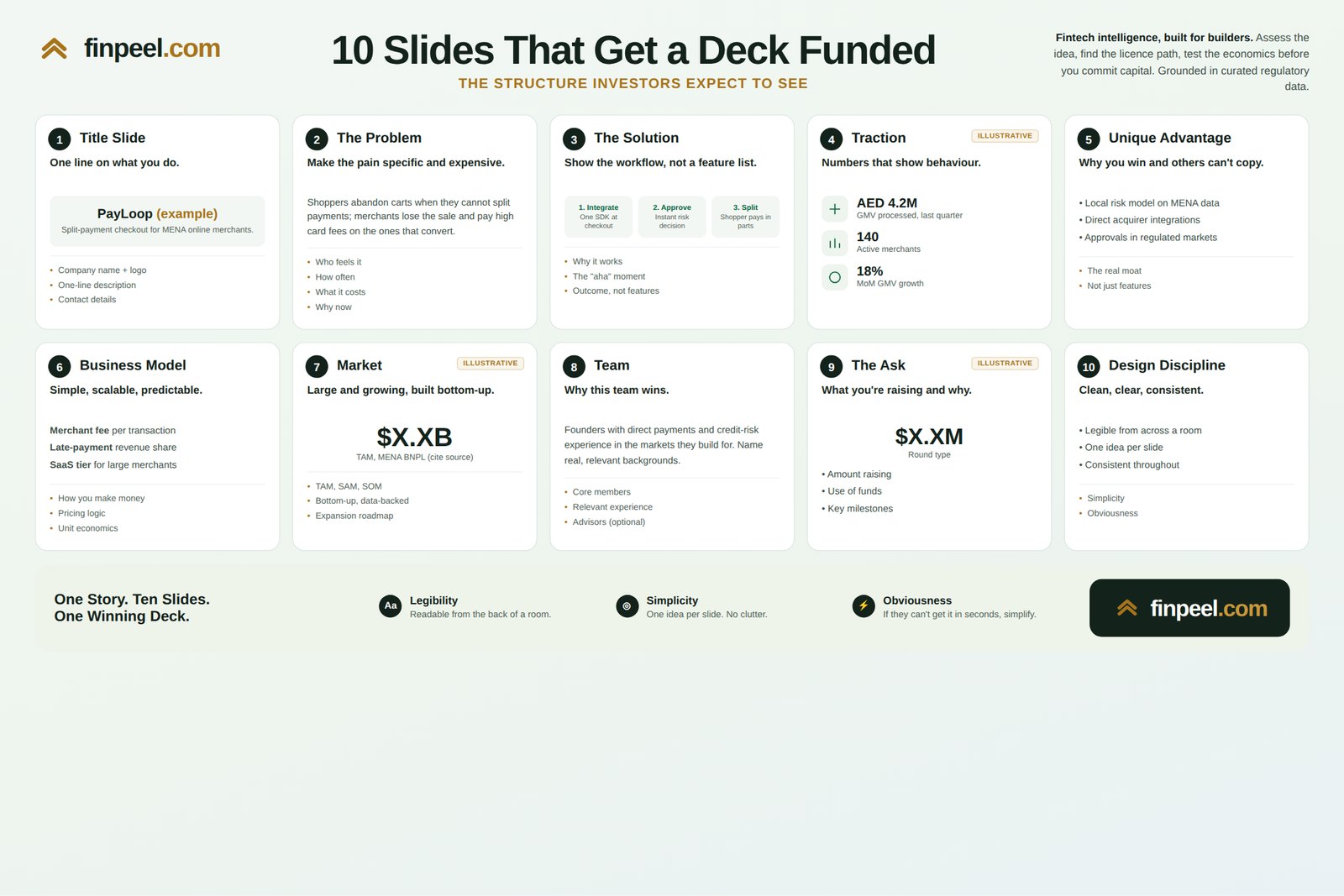
That distinction matters. A fintech pitch is rarely simple by default. It may involve regulation, payment flows, banking partnerships, fraud controls, credit risk, compliance, integrations and unit economics. The founder's job is not to explain every operational detail in the opening deck. It is to make the opportunity clear enough that investors want to continue the conversation.
Your deck has less than three minutes to work. Investors may receive hundreds of decks a year, many opened between meetings or late at night. The first review is not a deep analysis; it is a fast decision about whether the opportunity deserves more attention. The deck is being tested on three things: can the investor read it quickly, understand the business without your explanation, and remember the core story afterwards. If it fails one of these, more information will not save it. More content usually makes it worse.
Slide 1, the title. Company name, logo, a one-line description, and contact details. The hard part is the one line. "An intelligent digital ecosystem transforming financial services" sounds ambitious but explains nothing. "A compliance platform that helps UAE fintech teams identify regulatory gaps before launching new products" tells the investor the customer, the product, the market and the outcome. A useful formula: we help [specific customer] achieve [specific outcome] by [what the product does]. The first slide should reduce confusion, not manufacture curiosity through vagueness.
Slide 2, the problem. Most problem slides are too broad: "payments are inefficient," "compliance is complicated." True, but not yet investable. A strong problem slide answers who experiences it, how often, what it costs, why existing alternatives fall short, and why the customer cares now. "UAE fintech product teams often discover compliance gaps after development has started, causing launch delays, repeated legal reviews and expensive product changes" names the user, the moment of pain and the business consequence. Support it with one or two pieces of evidence, and avoid opening with a huge market statistic. The problem should feel real before it feels large.
Slide 3, the solution. Show the "aha," not the feature list. A backlog of AI chatbot, dashboard, real-time alerts, automated workflows and API integrations leaves the investor unsure of the core value. Show the workflow instead: the product analyses a proposed fintech product, maps its customer journey against relevant regulatory requirements, and produces a structured gap assessment before development begins. The test is simple: can an investor explain your product after seeing this slide once?
Slide 4, traction, often the most important slide early on. It moves the discussion from opinion to behaviour. Depending on stage and model, fintech traction can be revenue, active users, funded accounts, transaction volume, signed contracts, pilots, retention, approval rates, banking partnerships or regulatory progress. Use honest numbers. "12 enterprise pilots, 4 converted to paid contracts, average annual contract value AED 90,000" tells an investor more than "25,000 registered users." Show the shape of progress: what changed, over what period, what caused it, and whether it is repeatable. Do not hide a messy growth curve; explain it. Investors prefer an honest story over a suspiciously perfect chart.
Slide 5, the unique advantage. Founders confuse differentiation with features, and features can be copied. A real advantage comes from proprietary data, distribution access, exclusive partnerships, regulatory permissions, workflow depth, customer trust or network effects. The question an investor is really asking: once this works, what stops a larger player from doing the same thing next quarter?
Slide 6, the business model. Simple, scalable, predictable. State how you make money, the pricing logic, the revenue mix, and unit economics if you have them. A model an investor cannot restate in one sentence is a model that needs simplifying, not more boxes.
Slide 7, the market. Build it bottom-up, not by quoting a multi-billion-dollar industry report. Identify the first segment, estimate how many such customers exist, the realistic annual revenue per customer, the serviceable market, then the expansion path. TAM, SAM and SOM with logic an investor can test beats a large number with no derivation. For fintech, account for regulatory geography, eligible population, ticket size and realistic penetration.
Slide 8, the team. Why this team wins: relevant experience, direct exposure to the problem, and the specific insight that came from it. Name real backgrounds and, if useful, advisors. Founder-market fit is deeper than a former employer; it is the observation that feels earned.
Slide 9, the ask. What you are raising, how the funds will be used, the key milestones the round buys, and what success looks like at the next stage. Be specific about the amount and the outcomes, not just the number.
Slide 10, design discipline. Legibility, simplicity, consistency. Readable from across a room, one idea per slide, consistent styling throughout. If an investor cannot grasp a slide in seconds, simplify it until they can.
A pitch deck is not the place to include every detail about your company. It is the place to make the important details impossible to miss: the customer, the pain, the solution, the timing, the differentiation, the market, the traction, the team and the ask. Most decks are not rejected because the idea has no potential. They are rejected because they leave too much work for the investor. Ten clear slides, one memorable story, and enough evidence to earn the next meeting.